

Download Google Latitude – Real‑time location sharing, privacy‑focused, free app
Overview
Google Latitude was once the go‑to companion for anyone who wanted to keep friends and family in the loop about their whereabouts. Although the standalone app is no longer available for download, the service lives on through the web interface and integrates tightly with Google Maps. The core idea is simple yet powerful: share your current GPS‑derived location with a trusted circle, view their positions on a map, and coordinate meet‑ups without the endless back‑and‑forth of text messages.
Because Latitude leverages Google’s robust infrastructure, it inherits the same security standards and reliability that power Search, Gmail, and Maps. Users can control exactly who sees their location, set time‑based sharing windows, and even pause broadcasting with a single tap. This granular privacy model makes Latitude a safe choice for families with children, traveling professionals, or anyone who values transparency without exposing their movements to the public.
While the original mobile app required a GPS‑enabled device, today you can access Latitude from any modern browser on Windows, macOS, Android, or iOS, making it a versatile tool for both desktop and mobile scenarios. Whether you’re coordinating a weekend hike, checking in on a teen’s commute, or simply letting a coworker know you’re nearby for a quick coffee, Google Latitude turns location sharing into a frictionless experience.
Core Features & Benefits
- Real‑time location updates – GPS, Wi‑Fi, and cellular triangulation combine to provide accurate, near‑instant positioning on a dynamic map.
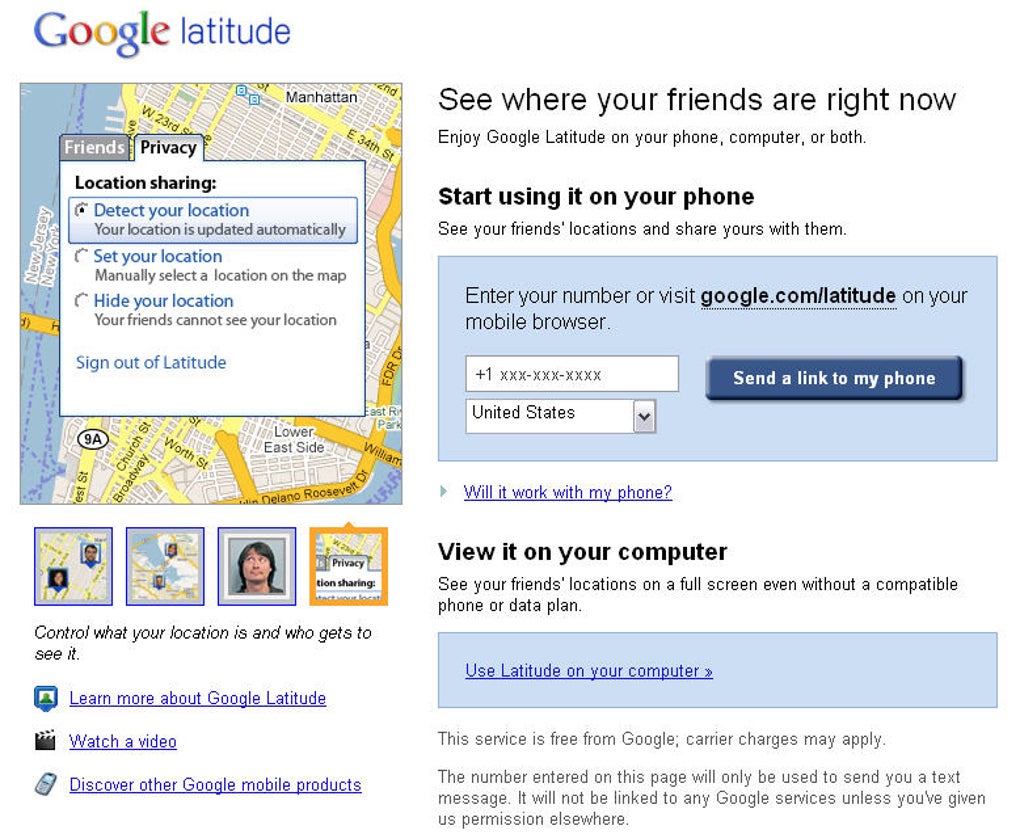
- Granular privacy controls – Choose exactly which contacts can see you, set time‑limited sharing, and toggle “invisible” mode whenever you need privacy.
- Seamless Google Maps integration – Latitude pins appear directly within Google Maps, allowing you to get directions, traffic data, and nearby points of interest without switching apps.
- Cross‑platform accessibility – Use Latitude from any browser on Windows, macOS, Android, or iOS; no dedicated app is required.
- Battery‑friendly operation – Location updates are intelligently throttled based on movement speed and network conditions, preserving device battery life.
- Group sharing & alerts – Create custom groups (e.g., family, teammates) and receive notifications when a member arrives at a predefined location.
- Historical location log – Review where you’ve been over the past 24 hours, useful for personal tracking or recalling a forgotten stop.
These features combine to make Google Latitude more than just a “find‑my‑friends” gadget. The service acts as a collaborative planning tool, giving users a visual context for their social interactions. For example, a parent can set a “home zone” and receive an alert when their child enters or leaves, while a sales team can monitor each other's proximity to key client sites.
Because Latitude is built on Google’s cloud, location data is stored securely, encrypted in transit, and only shared with explicitly authorized contacts. The ability to pause sharing with a single tap ensures that privacy is never compromised, even in public spaces or during sensitive meetings. Moreover, the integration with Google Maps means you can instantly calculate the fastest route to a friend’s location, view real‑time traffic, and even explore nearby restaurants or transit options—all without leaving the Latitude interface.
In short, the feature set is designed to be both powerful for power users and intuitive for casual users who simply want to let someone know they’re “on the way.”
Installation, Usage & Compatibility
Getting Started – No App Required
Since the dedicated Google Latitude app has been retired, the first step is to open a modern web browser on your device and navigate to google.com/latitude. Sign in with your Google account; if you don’t have one, you’ll need to create it—this also gives you access to Google Maps and other Google services. Once logged in, you’ll be prompted to enable location sharing.
On desktop browsers, the site will request permission to access your device’s location via the browser’s built‑in geolocation API. On mobile browsers, you’ll be asked to allow location access at the OS level (iOS or Android). Accepting these prompts activates real‑time tracking.
Step‑by‑Step Usage
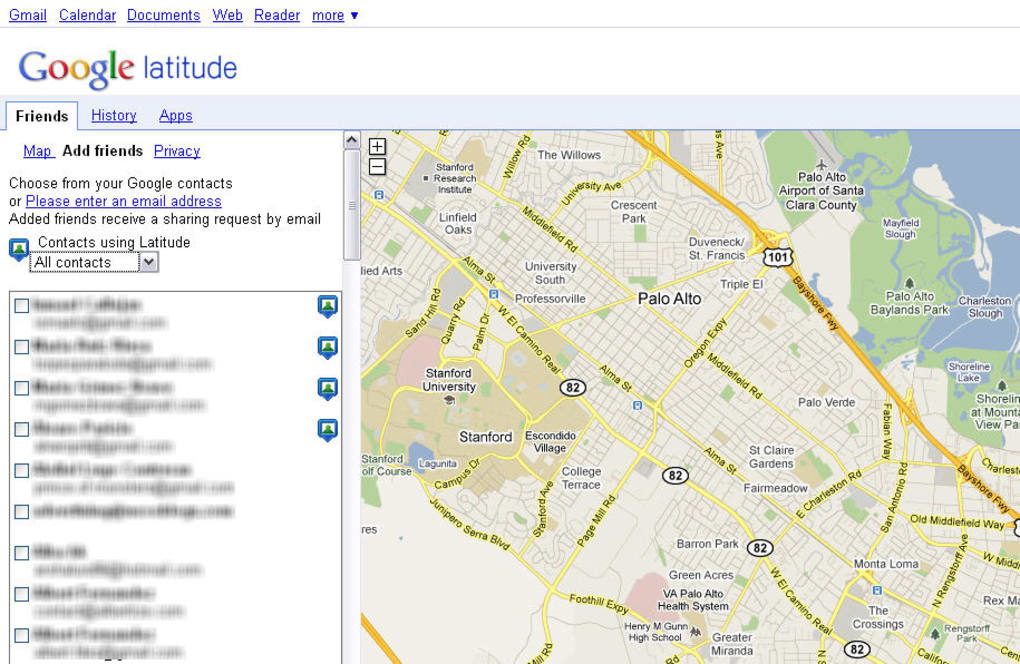
- Enable sharing: Click the “Share your location” toggle. Choose the contacts you wish to share with from your Google Contacts list.
- Set sharing preferences: Decide whether sharing is continuous, limited to a specific time window, or “invisible” for periods of privacy.
- View the map: Your current position appears as a blue dot on the map, while friends’ locations show as colored pins with their names.
- Interact with pins: Click a friend’s pin to see details such as last updated time, distance, and an optional message.
- Navigate: Use the built‑in “Directions” button to open Google Maps with a route to the selected friend’s location.
Compatibility (itemprop="operatingSystem")
Google Latitude’s web‑based interface works on all major operating systems that support a recent browser version:
- Windows 10/11 – Chrome, Edge, Firefox, or Safari (via Windows Subsystem for macOS)
- macOS 12+ – Safari, Chrome, or Firefox
- Android 9+ – Chrome or the native Android browser
- iOS 13+ – Safari or Chrome for iOS
Because Latitude relies on the device’s GPS chipset, any smartphone or tablet with built‑in GPS (most modern devices) can provide accurate positioning. For laptops without GPS, the service falls back to Wi‑Fi positioning, which is less precise but still functional in most urban areas. The service is fully responsive, automatically adjusting the UI for different screen sizes, so you get a consistent experience whether you’re on a 13‑inch laptop or a 6‑inch phone.
Pros, Cons, FAQ & Final Thoughts
Pros
- Free to use with a Google account
- Strong privacy controls and granular sharing options
- Integrated with Google Maps for seamless navigation
- Cross‑platform access via any modern browser
- Battery‑efficient location updates
Cons
- No longer available as a native mobile app, which some users prefer
- Relies on Google’s ecosystem; users without a Google account cannot participate
- Location accuracy may vary on devices without a dedicated GPS chip
- Limited to sharing within Google Contacts, not external messaging platforms
Frequently Asked Questions (FAQ)
Is Google Latitude still supported?
The standalone Latitude app was discontinued, but the service continues to operate via the web interface and is fully integrated with Google Maps.
Can I use Latitude without a Google account?
No. Latitude requires a Google account because it pulls contacts and privacy settings from Google’s ecosystem.
How accurate is the location data?
On devices with GPS, accuracy is within 5–10 meters. On Wi‑Fi‑only devices, accuracy depends on nearby Wi‑Fi networks and can be 20–30 meters.
Can I limit sharing to specific times of day?
Yes. Latitude lets you schedule sharing windows or manually toggle “invisible” mode whenever you want privacy.
Is my location data stored permanently?
Location history is kept for 24 hours unless you enable the optional “Location History” feature, which stores data for longer periods under Google’s privacy policy.
Conclusion & Call to Action
Google Latitude remains a solid, free solution for anyone who wants real‑time, privacy‑aware location sharing without the hassle of additional apps. Its deep integration with Google Maps, robust permission system, and cross‑platform accessibility make it a practical choice for families, teams, and travelers. While the lack of a native mobile app may be a drawback for power users, the web‑based experience is smooth and reliable on all major operating systems. If you’re already embedded in the Google ecosystem, enabling Latitude is a quick way to add a valuable layer of connectivity to your daily routine.
Ready to start sharing your whereabouts securely? Simply visit google.com/latitude, sign in with your Google account, and enable location sharing in a few clicks. Keep your friends in the loop, stay safe on the road, and enjoy the convenience of real‑time maps—all at no cost. Download isn’t required—just a browser and a willingness to stay connected.



.png)